
Xuhang Shi

AI Algorithm Engineer, DICT Center, China Mobile (Shaanxi)

I build reliability into multi-step AI systems: detecting, correcting, and calibrating errors in multi-hop retrieval and agent memory.

I'm an AI algorithm engineer working on multi-hop retrieval, cross-modal retrieval, and agent systems that run in production. My research asks what happens when one step of a long reasoning chain goes wrong, and how a system can notice and recover.

Research in one picture

What happens when one hop goes wrong?

Long reasoning chains fail one step at a time. My work is about catching that step and repairing it, without throwing the whole chain away.

Q Were the directors of Film A and Film B born in the same country?

Multi-hop question answering with fault detection and repairA question splits into two branches: find each film's director, then each director's birthplace, then compare. One birthplace hop returns contradicting evidence; it is flagged, re-retrieved, and the final answer cites four verified documents.conflicts with director(B)Qquestiondirector(A)director(B)birthplace(·)birthplace(·)compareanswerNo4 sources cited

01Decompose — The question becomes a graph of sub-questions with explicit dependencies.

Research interests

  1. 01

    Multi-hop Retrieval

    Decompose hard questions into dependent hops and retrieve evidence for each.

  2. 02

    Agent Memory

    Keep long-lived memory accurate: what to store, revise, and retract.

  3. 03

    Reliability

    Detect, localise, and repair the step that went wrong instead of starting over.

01 / Featured work

Projects at the intersection of retrieval, structured reasoning, and memory.

All projects

02 / Research index

Publications

Selected papers. The full list is on the publications page.

  1. arXiv 2026

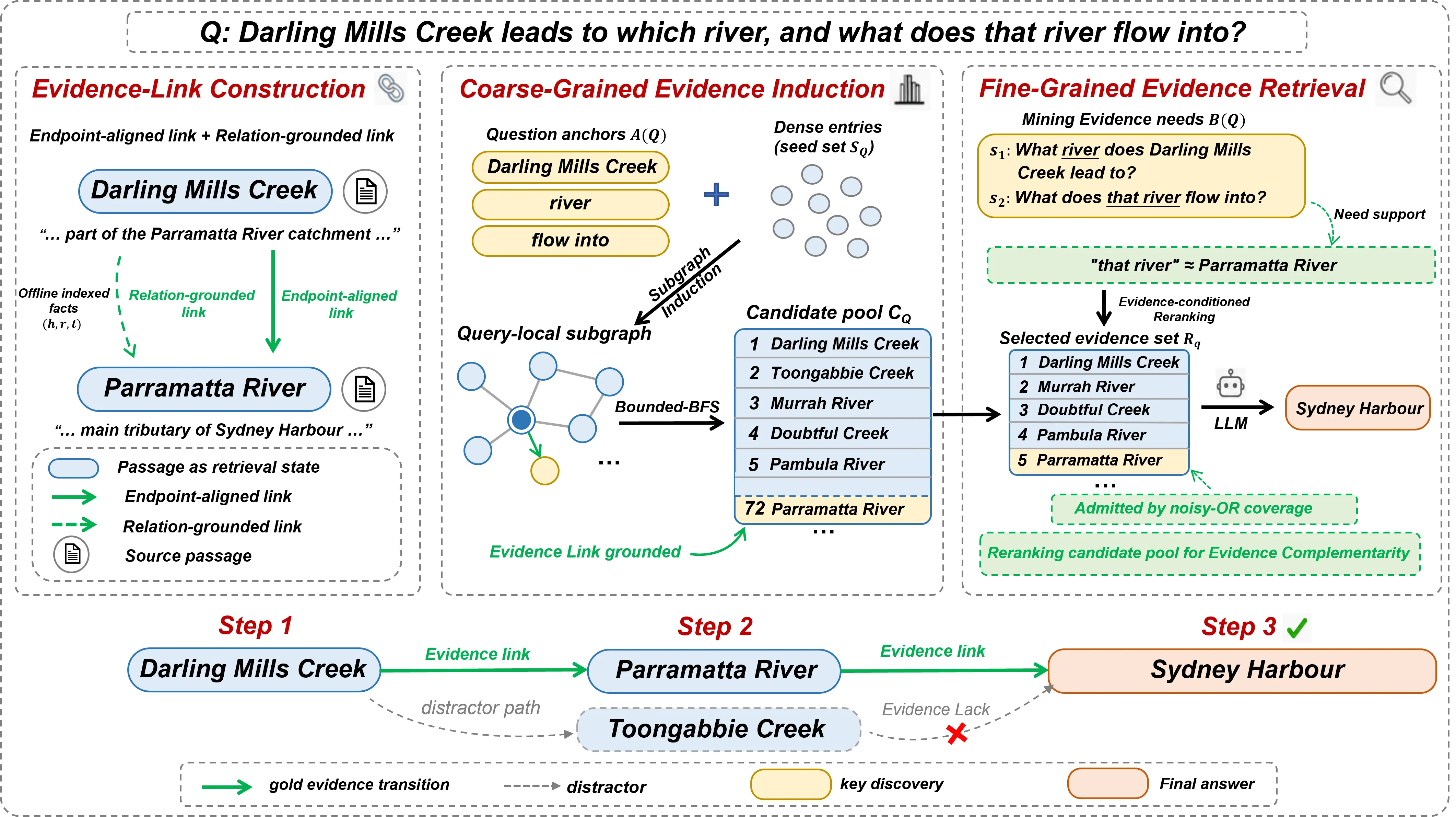
    EvLink: Source-Grounded Evidence Linking for Graph RAG

    Linyao Zheng, Xuhang Shi, Zhifang Mao, Sai Zhou, Shuaixian An, Xiuquan Hou

    arXiv for EvLink: Source-Grounded Evidence Linking for Graph RAG, opens in a new tabCode for EvLink: Source-Grounded Evidence Linking for Graph RAG, opens in a new tabProject for EvLink: Source-Grounded Evidence Linking for Graph RAG, opens in a new tab
    Abstract

    Graph-based Retrieval-Augmented Generation (GraphRAG) supports multi-hop reasoning by organizing corpora into structured graphs. However, graph reachability often captures semantic association rather than evidence support, so a reachable passage may still fail to justify a required cross-passage transition. We propose EvLink, an evidence-linking retriever that preserves passages as retrievable evidence units and builds evidence-supported transitions between them. EvLink constructs two types of reliable links: relation-grounded evidence links justified by explicit source relations, and endpoint-alignment links serving as source-bounded fallbacks. For retrieval, we introduce a two-stage retrieval strategy. First, bounded breadth-first search over source-grounded evidence links recovers bridge passages missed by similarity-based methods. Then, evidence-need mining with noisy-OR coverage refinement selects a compact, non-redundant evidence set satisfying distinct question facets. Experiments on three multi-hop and two simple QA benchmarks show EvLink consistently outperforms leading GraphRAG baselines with average gains of 2.4 R@5, 1.9 EM, and 2.4 F1.
  2. arXiv 2026

    RCER: Reconstructing Cross-Evidence Relations for Iterative Retrieval-Augmented Generation

    Linyao Zheng, Xuhang Shi, Zhifang Mao, Xiuquan Hou, Sai Zhou

    arXiv for RCER: Reconstructing Cross-Evidence Relations for Iterative Retrieval-Augmented Generation, opens in a new tab
    Abstract

    Iterative retrieval-augmented generation (RAG) accumulates knowledge from retrieved evidence to answer complex questions, but existing methods struggle to reconstruct entity correspondences and inferential dependencies across retrieved passages as new information emerges. We propose RCER, an iterative RAG method that reconstructs these cross-evidence relations directly from accumulated source passages. Inter-round relational evidence acquisition identifies entity correspondences and relational dependencies to drive dynamic problem decomposition and iterative retrieval. Reasoning context reconstruction independently constructs a coherent reasoning context through joint selection of complementary passages and derivation of cross-evidence inferences. Cross-evidence compositional reasoning leverages these inferences to establish entity correspondences and compose relations across selected passages for answer derivation. Experiments show that RCER outperforms the best baselines by 2.83 EM and 3.06 F1 points on average across three multi-hop QA benchmarks and achieves superior performance on narrative and implicit reasoning tasks.

  3. arXiv 2026

    LineageRAG: Harnessing GraphRAG by Constructing Evidence Lineages with Source Grounding

    Linyao Zheng, Xuhang Shi, Zhifang Mao, Sai Zhou, Shuaixian An, Xiuquan Hou, Jinze Li

    arXiv for LineageRAG: Harnessing GraphRAG by Constructing Evidence Lineages with Source Grounding, opens in a new tab
    Abstract

    Graph-based Retrieval-Augmented Generation (GraphRAG) retrieves evidence for multi-hop questions over structured corpus graphs. Existing GraphRAG methods leave the connection between evidence discovery and source grounding implicit. We propose LineageRAG, which constructs one evidence lineage for each query-derived evidence demand and completes it with a verbatim source span when the selected evidence supports that demand. LineageRAG first initializes the evidence demands. It then expands each lineage through demand-conditioned retrieval over the corpus graph while retaining the demand associated with every candidate. Lineage completion uses this provenance to select complementary passages and grounds supported demands in verbatim source text. Experiments on HotpotQA, 2WikiMultiHopQA, and MuSiQue show that LineageRAG improves R@5, EM, and F1 by 3.51, 5.96, and 5.22 points on average over leading GraphRAG baselines.

  4. arXiv 2026

    HELENA: Hierarchical Sparse Coordination over a Union of Complementary Topologies for MAS

    Zhifang Mao, Linyao Zheng, Xuhang Shi, Xiuquan Hou

    arXiv for HELENA: Hierarchical Sparse Coordination over a Union of Complementary Topologies for MAS, opens in a new tab
    Abstract

    LLM-based multi-agent systems (MAS) typically optimize a single topology, restricting reasoning to a narrow trajectory and limiting comprehensive analytical capacity. Naively merging multiple topologies into a composite graph introduces redundant noise propagation across irrelevant connections, degrading solution quality. To address this dilemma, we propose Hierarchical Sparse Coordination over a Union of Complementary Topologies for MAS (HELENA), a multi-agent framework that balances diverse reasoning paths with sparse task-dependent execution. HELENA constructs a union MAS graph from complementary candidate topologies selected via Monte Carlo Tree Search and Determinantal Point Process, broadening the reasoning trajectory for comprehensive analysis of complex problems. A Hierarchical Sparse Coordination module then activates only a sparse subgraph at each step while agents exchange compressed latent briefs to suppress redundant noise propagation. Finally, a Local Self-Refinement stage identifies decision units with discrepancy evidence and rewrites them only when contrastive evidence simultaneously confirms a reliable solution-side failure and a challenger-side improvement. Experiments across eight benchmarks show that HELENA achieves state-of-the-art results on all benchmarks, with an average gain of +3.47% over the strongest baseline and up to +10.34% on MMLU-Pro, achieving larger improvements on harder benchmarks at a reasonable additional cost.

Preview

Ready to copy.

Full publication list